
How important was the image of the warrior king in medieval England?
Richard The Lionheart and medieval military kingship

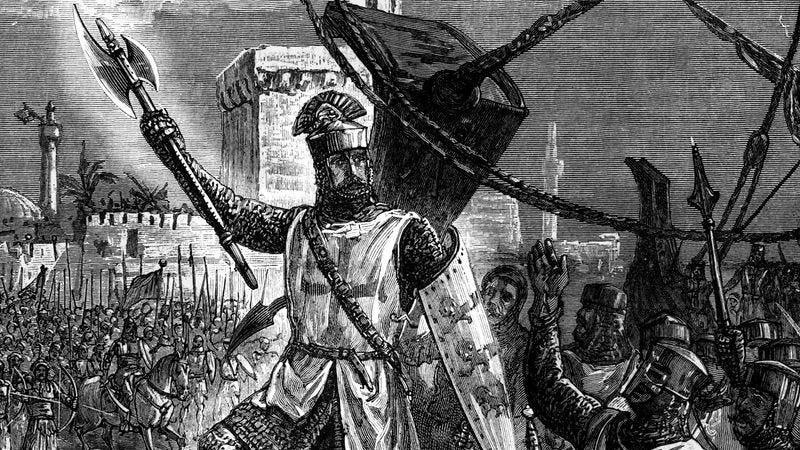
Richard I, “The Lionheart” is often hailed as one of England’s greatest warrior kings/ His reign has left a legacy that was persisted for the last 800 years. Richard’s success generally comes from his military exploits, namely his Crusade. But can we really consider a king who only spent 6 months of his 10 year reign in the land that he ruled a good ruler?
Military success, and the portrayal of a heroic and courageous king, was an integral part of kingship in the Middle Ages. Kings were expected to go to war and demonstrate significant martial ability and courage. Whether a king waged war physically or not, it was nonetheless crucial for his kingship to be perceived as being “warlike” in his authority. The art of kingship is best demonstrated through the reign of Richard I, whose legacy has persisted as the ultimate warrior king of England.
Even after his death, 13th and 14th century writers were still firm in their judgement of him as the model king whom his successors should strive to emulate. The study of Richard’s reign and his Crusade benefits from a rich body of source material that highlight his military exploits as well as the 12th century values of a warrior king that was held by many of Richard’s contemporaries.
The assumption that a king should always be a competent warrior was widespread and therefore had a significant impact on how a particular king was perceived. Thus many 12th century writers used military prowess and success as one of the ultimate defining characteristics of a ‘good king’. The Itinerarium Peregrinorum Et Gesta Regis Ricardi characterised Richard “first and foremost as an elite and most doughty knight” and goes on to state that a king such as he who is “endowed with such great valour […] certainly deserves to govern.” Furthermore, the Itinerarium describes Richard as being endued with “such virtues that he seemed rather to belong to earlier times than these.” This is drawing on the favourability that classical antiquity and its figures, such as Caesar and Alexander, held by many medieval chroniclers of Richard I’s day.
The Cistercian abbot, Ralph of Coggeshall described Richard as ‘rex bellicosus’ – king of war - in his Chronicon Anglicanum; highlighting the importance of successful military achievements for a king’s reputation. Coggeshall then, paints an idealized image of Richard as the greatest warrior of his age, in turn ascribing great value to the role of warfare in medieval kingship.
During Richard’s lifetime, he was described by his admirers as being “worthy of the chansons de geste.” For instance, an act of the Gascon monastery of La Reole in 1186 portrays Richard, as “miles probissimus” – a most accomplished knight. Richard’s military success set the standard for what a medieval king should be, and subsequent kings appeared to be judged by their own contemporaries on this value. The line “he shines like a new Richard” in regard to Edward I’s reign demonstrates the importance of this reputation in creating a legacy that maintains a standard of a king
It is clear that Richard was regarded as the “epitome of chivalric kingship” and that other kings during his reign and after paled in comparison. Phillip II of France also demonstrated the preoccupation of medieval rulers with warfare. Yet despite his military successes he was described by his contemporaries as “too soft” and looking “like a lamb” according to Bertran de Born. It is clear from de Born’s source that Philip lacked the militaristic charisma that Richard possessed, thus affecting his reputation. Richard of Devizes parallelled this description by also referring to Philip as “a lamb” while Richard was described as “a lion”.
Richard’s reputation as a competent warrior and general is down to his actions during the Third Crusade and the war against Saladin. Devizes went on to describe Richard as “a king worthy of the name king” and that his devotion was so great that “so hastily […] did he run to avenge the wrongs of Christ.” Through the coronation oath, Richard, as a king of England, promised to protect and uphold the Church. Thus, through this notion crusading was seen as a necessary part of his reign and kingship. Ambroise, an eye-witness to the Third Crusade, highlighted Richard’s leadership and gallantry in his Estoire de la guerre sainte, by ascribing him “the valour of Hector” and stating that “in courage he was equal to Alexander.” Ambroise described Richard as being with “a sword in hand, pursuing the Turks so ruthlessly […].”
There is no doubt historical value in Ambroise’s account, yet one must considered the motivation behind writing such a panegyric about Richard. Ambroise, likely under Richard’s lordship, wrote a glorious account; a possible piece of propaganda to bolster the king’s image. Yet even Arab chroniclers recounted his military prowess and charisma; stating that he “showed a burning passion for war” and that his “reputation and valour were greater” than that of the Franks. The existence of such a source from an opposing perspective adds more validity to sources such as Ambroise’s. These sources demonstrate the value that writers such as Ambroise, Bertran de Born and the author of the Itinerarium, ascribed to the role of warfare in relation to kingship.
However, it is this “burning passion for war” that has led to the modern opinion of Richard shifting from that of a heroic warrior, to a king who neglected his kingdom for war. Until the 1800s, Richard was regarded highly as one of the best kings of England. Yet modern historians saw Richard as an absent king who valued war more highly than governing his kingdom. Runciman argued that although Richard was a “gallant knight and splendid soldier” he was at the same time “a bad king, husband and son.”
Is it then acceptable to surmise that medieval chroniclers valued the perception of a competent, militaristic king over one who was deemed an effective governor? Markowski argues that Richard’s Crusade was in fact a failure and that despite this, Richard’s writers continued to “lionize” him. Therefore, the way Richard’s writers employed a level of “myth-making” in order to bolster his image, tells us a lot more about the writers themselves and their audiences.
Kings were judged based on their military ability, so it is therefore important to portray him in such a way. For an English audience, it was crucial that their king appeared as a valiant and noble warrior, or else how could he ever be respected? Richard conformed to the ideal image of a king in the 12th century. Modern historians’ criticisms are merely a result of the shift in what we value the most in a ruler.
In contrast, the glorification of these warlike values was not shared by men of the church who, during the 12th century, acted as the key “diffusers” of ideology. In addition, not all writers of the Middle Ages evaluated kings based purely on the military successes. Ralph of Coggeshall who once praised Richard’s military abilities later criticised him for the financial extortions he enacted in his later years. While Raoul of Caen and Fulcher of Chartes both deplored the idea of kings behaving as knights as it was detrimental to their leadership.
In conclusion, it is clear that Richard successfully fulfilled the expectations held by many of his contemporaries regarding good kingship. In the latter half of the 12th century with the rise of chivalry, a king became expected to be a competent warrior as well as governing over his realm. The primary sources outlined here demonstrate how medieval writers valued the role of warfare for the reputation of a king and how Richard fulfilled it. Richard was considered by his contemporaries as an exceptional king that emulated figures from antiquity such as Alexander.
It was necessary for a king to justify and legitimise his rule and by partaking in warfare he was able to enact this. As a Christian ruler it was also his duty to defend and uphold values of the Church, and so by going on Crusade, Richard was fulfilling yet another of his oaths that he took during his coronation. Richard was considered a model king and the standard to which any successive ruler should aspire.
On the other hand, he was the standard by which a king was judged to have fallen short; with King John’s reign being a prime example. It also should be noted that this notion of a ruthless warrior king was not shared by everybody in medieval society; notably churchmen who placed more value on a king being present within his kingdom, rather than waging war elsewhere.
Therefore, the sources have demonstrated that warfare itself was an inseparable part of medieval kingship; it is, however, important to consider the possible biases that English chroniclers may have been writing with in regards to Richard. In any case, the sources regarding Richard’s kingship from the point of view of the Muslim chroniclers adds more weight to the validity of the such sources.